Training Featured
Breath-Hold Training for Spearfishing: A Beginner's Dry-Training Plan
You need less bottom time than you think — and CO₂ tolerance, not lung volume, is what is holding it back. A full six-week dry plan.
7 min read
Science-based guides on CO₂ tolerance, dry apnea training and freediving — with free interactive tools you can use right here in your browser.
You need less bottom time than you think — and CO₂ tolerance, not lung volume, is what is holding it back. A full six-week dry plan.
A double inhale and a long, slow exhale. One of the best-supported quick calming tools — with a real RCT behind the mood benefit, and an honest look at what it did not change.
You cannot stretch your lungs bigger. What you can train is ribcage and diaphragm flexibility — and that changes how a breath hold feels. A dry, guided routine.
Cold water on the face genuinely slows your heart through the vagus nerve. Here is the real physiology, how freedivers use it, and where the wellness claims outrun the evidence.
One table shrinks the rest, the other grows the hold. Same goal, opposite mechanics — and a very different risk profile. Here is how to tell them apart and when to use each.
Breath work is a lever on CO₂ tolerance, breathing economy and comfort — not on your VO₂max ceiling. What the runner studies really show, plus a dry protocol.
A myth-check of the BOLT score: a genuinely useful personal signal of CO₂ tolerance — but not the validated performance predictor the "40-second ideal" makes it sound like.
Before you train, measure. A guided dry test — paced breathing, one relaxed max hold — and an honest reading of what your result means.
Pranayama’s retention and a freediver’s CO₂ table are the same mechanism in different vocabularies. What holds up under measurement — and what does not.
Movement makes CO₂ faster. Apnea walks turn that into the most time-efficient dry tolerance session there is — with a configurable interval timer.
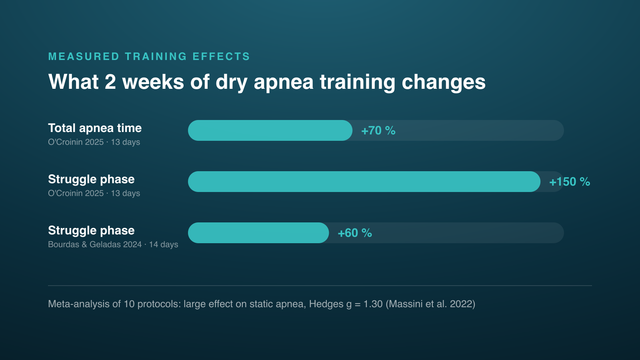
Four peer-reviewed studies, no hype: what breath-hold training actually changes, how fast, and which popular claims the measurements refuse to back.
The urge to breathe is a CO₂ alarm, not an oxygen alarm. Here is how CO₂ tables train that alarm — and how to build one from your current max.