
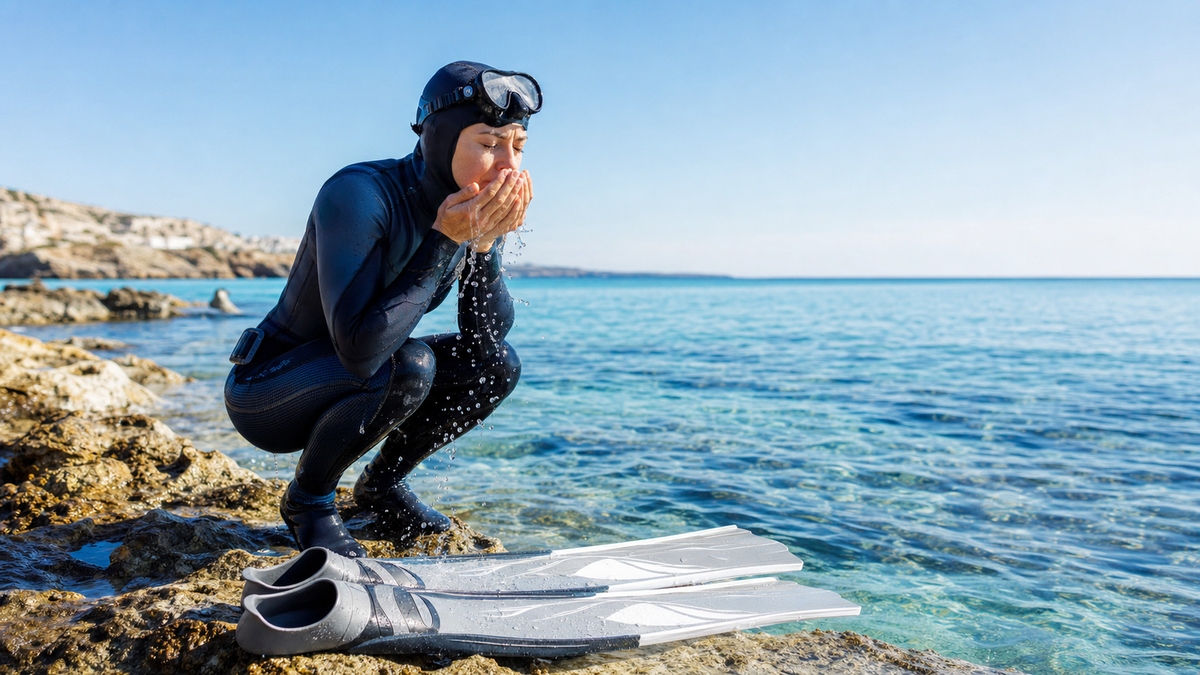
The mammalian dive reflex is a real, reliable, oxygen-conserving response: put cold water on your face and your heart slows, blood shifts to your core, and your body starts rationing oxygen for the heart and brain. It is one of the most robust reflexes in human physiology — and also one of the most oversold. The mechanism is solid science. The wellness claims stacked on top of it usually are not.
Key takeaways
- The trigger is cold water on the face, not the breath hold. Cold receptors around the eyes, forehead and nose feed the trigeminal nerve, which drives a vagal slowing of the heart within seconds.
- Three responses run together: bradycardia, peripheral vasoconstriction, and a blood shift with spleen contraction. All three stretch the oxygen you already have.
- The reflex is trainable. Over 13 days of beginner practice, the diving heart-rate drop landed roughly in the −10 to −20 bpm range and arrived earlier in the hold.
- The acute effects are well measured; the wellness claims are not. No study shows that face immersion cures anxiety, permanently “tones the vagus”, or boosts immunity or longevity.
What the dive reflex actually does
The dive reflex is a set of coordinated changes your body makes the moment it thinks you are submerging. William Panneton’s landmark review calls it “an enigmatic reflex to preserve life,” and describes three core responses working together (Physiology, 2013, DOI 10.1152/physiol.00020.2013):
- Bradycardia is a drop in heart rate below its normal resting level. A slower heart burns less oxygen per minute.
- Peripheral vasoconstriction is the clamping down of the blood vessels in your arms and legs, which steers oxygen-rich blood toward the organs that cannot tolerate a shortage: the heart and the brain.
- A blood shift and spleen contraction — blood redistributes toward the core, and the spleen squeezes out a reserve of red blood cells, a slower boost that builds over repeated holds.
Together these do one thing: they stretch the oxygen you already have. The reflex is shared across diving mammals — seals, dolphins, otters — and humans carry a muted version of the same wiring. It is not something you learn. It is something you trigger.
Cold on the face is the switch
Here is the part that surprises people: the trigger is not holding your breath. It is cold water on your face — specifically around the eyes, forehead and nose. That is what makes the reflex usable on dry land.
Cold receptors in that patch of skin feed into the trigeminal nerve. The trigeminal nerve is the big sensory nerve of the face, and it is the input side of the whole reflex. The signal runs to the brainstem and back out along the vagus nerve. The vagus nerve is the main parasympathetic (“rest-and-digest”) line from the brainstem to the heart, and it tells the pacemaker to slow down, so the bradycardia follows within seconds. Panneton traces exactly this pathway — trigeminal input driving a parasympathetic cardiac response (Physiology, 2013, PMID 23997188).
Two details matter for anyone trying this. First, temperature does most of the work: colder water produces a stronger, faster heart-rate drop than tepid water. For example, a bowl of cold tap water with a few ice cubes dropped in will pull your pulse down further and sooner than the same bowl left standing at room temperature — same breath, different trigger strength. Second, the face has to be wet — apnea alone gives you some of the reflex, but adding cold facial immersion deepens it. The widget below walks the full chain, one link at a time.
Follow the dive reflex
Cold water on the face starts a chain that slows your heart and shifts blood to your core. Tap each step to see what it does.
-
Cold receptors around the eyes and forehead fire the moment your face meets cold water — the trigger the rest of the reflex needs.
-
The signal runs to the brainstem and out along the vagus nerve, the main parasympathetic (rest-and-digest) line to the heart.
-
The heart slows — often by 10 to 20 beats per minute, sometimes far more — cutting how fast you burn oxygen.
-
Vessels in the arms and legs narrow, steering oxygen-rich blood to the heart and brain.
-
The spleen squeezes a reserve of red blood cells into circulation, a slower boost that builds over repeated holds.
Tap a step
How freedivers use it
For a freediver the dive reflex is not a party trick — it is free performance. A slower heart burns less oxygen, so a diver who can trigger a strong reflex early has more breath-hold time for the same lung of air.
That is why the breathe-up before a dive is slow, quiet and cold-tolerant: the calmer and more parasympathetic you are, the earlier the bradycardia arrives and the deeper it goes. And it is trainable. In a 13-day beginner study, diving bradycardia deepened with practice. The same O’Croinin dataset the rest of this blog leans on put the trained heart-rate drop roughly in the −10 to −20 bpm range. It also arrived earlier in the hold as participants adapted (Applied Physiology, Nutrition, and Metabolism, 2025, DOI 10.1139/apnm-2025-0033). Elite divers can push far past that, but −10 to −20 bpm is a realistic, well-documented adaptation for ordinary people over two weeks.
The methodology behind that range is worth knowing before you borrow it: these were beginners, training daily for under a fortnight, measured dry. It is not an elite ceiling and it is not a claim about what you will hit in open water.
For instance, if you sit at 70 bpm before a hold, a trained −15 bpm response has you working at around 55 bpm within the first minute. Same lungful of air, a noticeably lower burn rate.
The practical takeaway: relaxation is not a soft skill in apnea, it is a physiological lever. A tense diver fights the reflex; a calm one recruits it.
Solid science vs cold-water hype
This is where honesty matters, because the dive reflex has been adopted as the mechanism behind a lot of wellness marketing. Let us separate what the measurements support from what they do not.
| Claim | Verdict |
|---|---|
| Cold water on the face slows the heart | Solid. Directly measurable, repeatable, well-mapped to the trigeminal–vagus pathway. |
| It produces a genuine parasympathetic (vagal) shift | Solid. This is the defining feature of the reflex. |
| It steers blood to heart and brain and conserves oxygen | Solid. Core to Panneton’s review and the reason the reflex exists. |
| A face-in-cold-water “reset” can calm you in a high-arousal moment | Plausible, short-term. The acute bradycardia and vagal shift are real; the felt calming is consistent with that. |
| It “cures” anxiety, “heals” the nervous system, or permanently “tones the vagus” | Overreach. No study shows a lasting cure of a clinical condition from face immersion. |
| It boosts immunity, metabolism or longevity | Not supported by the dive-reflex literature. |
Summary
The reflex is real and its acute effects are measurable — a slower heart, a parasympathetic shift, oxygen conservation. What the evidence does not show is that triggering it repeatedly treats anxiety disorders, rewires your baseline stress physiology, or does any of the sweeping things “vagus nerve” content tends to promise. A real, short-lived autonomic response has been inflated into a cure-all. The physiology deserves better than the marketing.
If you want to go deeper on why the urge to breathe is a separate system from the dive reflex, the BOLT test piece covers it and shows how to measure your own CO₂ tolerance. The broader training-science article puts the reflex in context with the rest of what actually adapts.
Trying the Dive Reflex safely at home
You can test the dive reflex today without any risk or traveling:
- Fill a bowl with cold water. Cold tap water works; a few ice cubes make the effect stronger. Have a towel ready.
- Sit down at a table, take a normal breath — not a maximal one — and hold it.
- Lean forward and lower your face into the water, covering your forehead, eyes and nose. Do not submerge your mouth-and-nose beyond a comfortable dip, and do not try to max-breath-hold underwater.
- Stay for as long as it is comfortable, then lift your face out and breathe normally. That is the whole exercise.
- Never do this alone in a bath, sink or pool, never lying down, and never combined with a maximal breath-hold. The reflex you are feeling is the same one that makes water dangerous — a blackout with your airway submerged is silent and fast.
Done seated over a bowl, this is a benign way to feel a genuine physiological reflex. Done in water, over-breathed, or alone, it is exactly the setup that drowns people. The gap between those two is entirely about respecting the airway.
Sources
- Panneton, W. M. (2013). “The mammalian diving response: an enigmatic reflex to preserve life?” Physiology (Bethesda) 28(5):284–297. DOI 10.1152/physiol.00020.2013 · PMID 23997188
- O’Croinin, O. et al. (2025). Applied Physiology, Nutrition, and Metabolism. DOI 10.1139/apnm-2025-0033
Every source above links to its abstract, and each link was opened and re-read against this text during the last editorial pass. Where a study measured trained athletes rather than beginners, for example, the article says so instead of generalising.
Written by Jan Luther — keen amateur freediver, and the developer behind Apnea Trainer since 2010. About this blog explains how sources are chosen; the imprint has the contact details for corrections. All articles
Frequently asked
How do you activate the mammalian dive reflex?
Cold water on the face — around the eyes, forehead and nose — is the trigger, not the breath hold itself. Sit at a table, hold a normal breath, and lower your face into a bowl of cold water for as long as it stays comfortable. Colder water gives a stronger and faster heart-rate drop, and the face has to be wet — apnea alone gives you only part of the reflex.
Why does cold water on the face slow your heart rate?
Cold receptors in the skin around the eyes, forehead and nose feed into the trigeminal nerve, the main sensory nerve of the face. The signal travels to the brainstem and back out along the vagus nerve, the main parasympathetic line to the heart, which tells the pacemaker to slow down. The bradycardia follows within seconds. Panneton's 2013 review traces exactly this pathway.
How much does the dive reflex slow your heart rate?
In a 13-day beginner study, the trained heart-rate drop landed roughly in the −10 to −20 bpm range and arrived earlier in the hold as participants adapted. Elite freedivers can go far beyond that, but −10 to −20 bpm over two weeks is a realistic figure for an ordinary person.
Does the dive reflex reduce anxiety?
The acute effects are real — a slower heart, a parasympathetic shift — and a short-term calming effect in a high-arousal moment is consistent with that. What the literature does not show is that repeated face immersion treats an anxiety disorder, permanently "tones the vagus" or rewires your baseline stress physiology. Treat it as a state tool, not a therapy.

Apnea Trainer is a breath-hold training app for iPhone, Apple Watch and Android. It guides you through timed breathing cycles and builds progressive tables around your personal bests. On Apple Watch the whole session runs on your wrist — live heart rate and haptic cues for every phase.
Keep reading
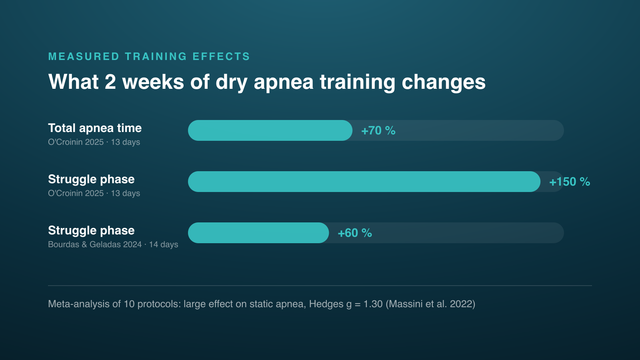
What Science Says About Breath-Hold Training: 4 Studies in Plain English
Four peer-reviewed studies, no hype: what breath-hold training actually changes, how fast, and which popular claims the measurements refuse to back.

The BOLT Score: What This CO₂ Tolerance Test Really Tells You (and What It Doesn't)
A myth-check of the BOLT score: a genuinely useful personal signal of CO₂ tolerance — but not the validated performance predictor the "40-second ideal" makes it sound like.