

Kumbhaka is the retention phase of pranayama — the pause after the inhale or after the exhale. Strip away the vocabulary and it is the same stimulus a freediver trains with a CO₂ table: a deliberate, controlled rise in carbon dioxide that you meet with relaxation instead of alarm. The two traditions arrived at the same physiology from opposite directions, and each one has something the other lacks.
Key takeaways
- Kumbhaka and a CO₂ table are the same stimulus described in two vocabularies: a controlled rise in carbon dioxide, met calmly.
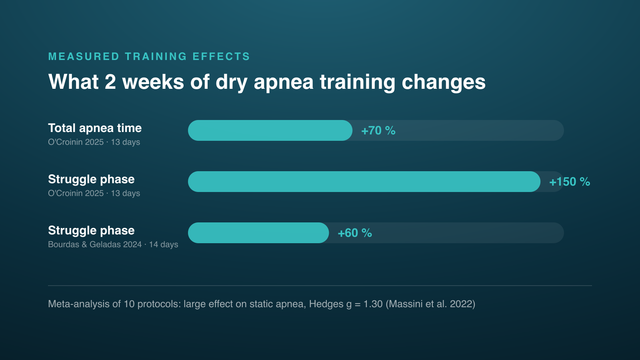
- Tolerance responds fast. Two weeks of daily dry holds lengthened the struggle phase by 59.7 percent on average (Bourdas & Geladas, 2024).
- What retention does not do is add oxygen. Saturation falls during a hold; training only slows the fall.
- Any protocol that has you breathe hard and fast before holding is doing something categorically different, and carries a real blackout risk. The studied protocols contain no hyperventilation.
What kumbhaka actually is
In classical pranayama the breath has four parts, and retention is two of them:
- Puraka is the inhale.
- Antara kumbhaka is retention with the lungs full.
- Rechaka is the exhale.
- Bahya kumbhaka is retention with the lungs empty.
Traditional texts treat kumbhaka as the centre of the practice rather than a pause between the interesting parts, and they are consistent on one point: retention is approached gradually, on a foundation of relaxed, even breathing, and never forced.
That instruction turns out to be sound advice for reasons the texts could not have known. The measured gains from breath-hold work show up over weeks of unforced practice, not in a single hard session — 13 days of daily holds raised total apnea time by 70 % in beginners, and almost none of it came from the comfortable part of the hold (O’Croinin et al., 2025, DOI 10.1139/apnm-2025-0033).
The physiological bridge
A freediver holding a full breath and a practitioner in antara kumbhaka are doing the same thing to their blood chemistry. CO₂ rises, chemoreceptors in the brainstem and carotid bodies register the change, and the urge to breathe switches on — typically only 3–5 mmHg above the resting CO₂ value. Meeting that signal calmly, repeatedly, is the trainable skill in both practices.
Two measured consequences carry across:
- Tolerance grows fast. Two weeks of daily dry apnea lengthened the struggle phase by an average of 59.7 % (Bourdas & Geladas, 2024, PMID 37797907). In a 13-day beginner protocol, total apnea time rose 70 % while the comfortable phase barely changed (O’Croinin et al., 2025, DOI 10.1139/apnm-2025-0033).
- The effect is not confined to breathing. In the same 2025 study, the heart-rate response to a Stroop test — an unrelated cognitive stressor — was blunted after training (10 ± 7 → 6 ± 5 bpm, p = 0.009). A calmer response to an internal alarm generalised to an external one.
Bahya kumbhaka, the empty-lung retention, adds a second variable: with less oxygen in reserve, the CO₂ signal and mild intermittent hypoxia arrive together and sooner. That makes it a stronger stimulus per second and a worse place to be careless.
The two vocabularies map onto each other almost term for term:
| Pranayama | Freediving | What is happening |
|---|---|---|
| Puraka | The breathe-up inhale | One comfortable breath, around 80 % full |
| Antara kumbhaka | Full-lung static hold | CO₂ climbs, chemoreceptors fire, you stay relaxed |
| First discomfort | First contraction | End of the easy-going phase |
| Sthira sukham (steady ease) | Struggle-phase tolerance | The part that actually grows with training |
| Rechaka | The recovery exhale | Long, unforced, parasympathetic |
| Bahya kumbhaka | Empty-lung hold / FRC hold | Stronger stimulus per second, smaller margin |
What is solid and what is not
Breathwork attracts big claims. Three worth separating:
“Retention supersaturates your blood with oxygen.” No. A held breath adds no oxygen; saturation falls slowly during the hold, faster with an empty-lung retention. What improves with training is the rate — Engan et al. (2013) measured a nadir SpO₂ of 84 % before training versus 89 % after, at matched hold duration.
“Regular retention boosts EPO and red blood cells.” Not on this timescale. In the same Engan study, haematocrit and haemoglobin were unchanged after two weeks of daily training (Scandinavian Journal of Medicine & Science in Sports, 23:340–348). Short-term spleen contraction is a real and separate phenomenon; sustained haematological adaptation is a different question with a different, much longer timescale.
“It calms the nervous system.” This one has support, with a caveat. Both the deepening dive bradycardia and the blunted Stroop response point at autonomic change. But the methodology is narrow: these are small studies of apnea training specifically, not a blanket endorsement of every breathwork protocol on the internet. Notably, the protocols that produced these results contain no hyperventilation. Any practice that has you breathe hard and fast before holding — such as the fast-breathing rounds popular in some modern breathwork courses — is doing something categorically different and carries a real blackout risk.
A simple, safe kumbhaka sequence
Use the pacer below. Start with a 4-4-6 ratio: inhale 4, retain 4, exhale 6. Nasal breathing throughout, shoulders down, jaw loose. Keep it unforced — the two-week training effects reported by Bourdas and Geladas (2024, PMID 37797907) came from daily, repeatable holds, not from single maximal efforts.
Guided breathing pacer
Guidelines that keep this safe and useful:
- Sit upright, seated or cross-legged, never lying in water. As with every hold on this site: dry, land, supported.
- Progress the retention, not the effort. Extend the retention by 1–2 seconds per week. For example, a 4-4-6 ratio becomes 4-6-6 after two weeks, not 4-12-6 after one good session. If the following exhale is ragged, the retention was too long.
- Keep the exhale longer than the inhale. The long exhale is what shifts you towards parasympathetic tone.
- For empty-lung retention (bahya kumbhaka), let the exhale be passive. No forced squeeze, no bearing down, and keep the first attempts to a few seconds.
- Stop for the day at dizziness, tingling, or any urge to gasp on the next inhale. 10–15 minutes is a full session.
From pranayama to structured apnea training
If you already practise kumbhaka daily, you have the two hardest ingredients of breath-hold training: the ability to sit still and a relaxed relationship with the pause. What you are usually missing is measurement and progression.
That is a small step to take:
- Measure a baseline — one relaxed maximum hold, dry, after two minutes of calm breathing.
- Set your table hold at 50–60 % of that number and run a CO₂ table three times a week.
- Keep your pranayama practice as it is. It is doing the relaxation half of the job.
- Re-test every two weeks.
The traditions do not conflict. One brings attention and a long history of gradual, unforced practice; the other brings a stopwatch and an effect size.
Sources
- O’Croinin, O. et al. (2025). Applied Physiology, Nutrition, and Metabolism. DOI 10.1139/apnm-2025-0033
- Bourdas, D. I. & Geladas, N. D. (2024). Respiratory Physiology & Neurobiology 319:104168. PMID 37797907
- Engan, H. et al. (2013). Scandinavian Journal of Medicine & Science in Sports 23:340–348. PMID 23802288
Every source above links to its abstract, and each link was opened and re-read against this text during the last editorial pass. Where a study measured trained athletes rather than beginners, for example, the article says so instead of generalising.
Written by Jan Luther — keen amateur freediver, and the developer behind Apnea Trainer since 2010. About this blog explains how sources are chosen; the imprint has the contact details for corrections. All articles
Frequently asked
What is the difference between antara and bahya kumbhaka?
Antara kumbhaka is retention with the lungs full, after the inhale. Bahya kumbhaka is retention with the lungs empty, after the exhale. The empty-lung version brings the CO₂ signal and mild hypoxia on sooner, which makes it a stronger stimulus per second and a worse place to be careless.
Is kumbhaka the same as CO₂ table training?
Physiologically, yes — both are a deliberate, controlled rise in carbon dioxide met with relaxation rather than alarm. What pranayama usually lacks is measurement and progression; what breath-hold training often lacks is the unforced, gradual approach the classical texts insist on.
Does breath retention increase oxygen in the blood?
No. A held breath adds no oxygen, and saturation falls during the hold. What training improves is the rate of the fall — Engan et al. (2013) measured a nadir SpO₂ of 84 percent before training versus 89 percent after, at the same hold duration.
How long should I hold in kumbhaka as a beginner?
Start with a 4-4-6 ratio — inhale four, retain four, exhale six — and add one to two seconds of retention per week. If the exhale after the hold is ragged, the retention was too long. Ten to fifteen minutes is a full session.

Apnea Trainer is a breath-hold training app for iPhone, Apple Watch and Android. It guides you through timed breathing cycles and builds progressive tables around your personal bests. On Apple Watch the whole session runs on your wrist — live heart rate and haptic cues for every phase.
Keep reading
CO₂ Tables Explained: The Science of Training Your Urge to Breathe
The urge to breathe is a CO₂ alarm, not an oxygen alarm. Here is how CO₂ tables train that alarm — and how to build one from your current max.
What Science Says About Breath-Hold Training: 4 Studies in Plain English
Four peer-reviewed studies, no hype: what breath-hold training actually changes, how fast, and which popular claims the measurements refuse to back.