

You cannot meaningfully grow your lungs — but you can make the cage around them more flexible. Maximum lung volume is largely set by your anatomy. What stretching genuinely improves is how freely your ribcage expands, how far your diaphragm travels, and how relaxed a full or empty breath feels. That is worth training. It is also the part of freediving practice where safety rules matter most, so read the box below before anything else.
TL;DR
- Total lung capacity is structural. Height, sex, age and the size of your thoracic cavity set it — those are exactly the variables the international spirometry reference equations use to predict it — and stretching does not move them.
- Lung volume genuinely predicts apnea performance: Schagatay et al. (2012) found spleen and lung volumes predicted results in apneic divers. That is an inherited starting point, not a training target.
- What is trainable is the wrapper: ribcage compliance, diaphragm travel, and comfort at the extremes of full and empty. That is what changes how a hold feels.
Flexibility is trainable, volume mostly is not
The internet is full of promises that a stretching routine will “add a litre” to your lungs. Standard respiratory physiology says otherwise. Total lung capacity is the full volume of air your lungs hold at a maximal inhale. It is set largely by height, sex, age and the size of your thoracic cavity. Those are precisely the variables the multi-ethnic spirometry reference equations use to predict a normal value across the 3–95-year age range (Quanjer et al., 2012, PMID 22743675). It is a structural property, like your wingspan. No amount of stretching turns a 6-litre pair of lungs into an 8-litre pair.
For example, a 1.90 m man and a 1.60 m woman of the same age will have very different predicted total lung capacities before either of them has trained a single day. That gap comes out of the reference equations, not out of anyone’s training log.
Volume is not irrelevant, though — it just is not yours to train. Schagatay and colleagues measured divers directly and found that spleen and lung volumes predicted performance in human apneic divers (Frontiers in Physiology, 2012, PMID 22719729). Read that the honest way round: the anatomy you inherited helps, and the part you can act on is everything else.
So why do experienced freedivers stretch religiously? Because the usable breath is not only about the container — it is about everything wrapped around it:
- Ribcage compliance is how readily your chest wall and intercostal muscles yield to an inhale. Stiff intercostals mean part of your breath is spent fighting your own tissue; a supple ribcage lets you reach a comfortable full breath with less effort and less tension.
- Diaphragm mobility is how far the diaphragm travels between a full inhale and a full exhale. A diaphragm that moves freely makes both the inhale and the long, passive exhale of a breathe-up smoother — and tolerates the contractions of the struggle phase with less panic.
- Relaxation at the extremes. A full inhale that feels strained costs oxygen through muscle tension alone. Stretching teaches your body that “full” and “empty” are safe places to be.
Inhale stretch vs exhale stretch: what each one opens
The two halves of the routine work opposite ends of the range, and they are not interchangeable.
| Inhalation stretch | Exhalation stretch | |
|---|---|---|
| Lung state | Comfortable ~80 % inhale — never a maximal pack | Fully exhaled, relaxed empty lungs |
| What it opens | Chest wall, side ribs, intercostals — the “expansion” end | Diaphragm upward travel, lower ribs, the “compression” end |
| Feels like | A tall, open chest; gentle width across the ribs | Belly hollow, ribs softening inward and down |
| Main risk | Dizziness and blackout risk if combined with packing or long full-lung holds | Low when done gently; stop on any light-headedness |
| Who benefits most | Anyone with a desk-rounded, stiff upper back | Depth-oriented freedivers, and anyone whose exhale feels “stuck” |
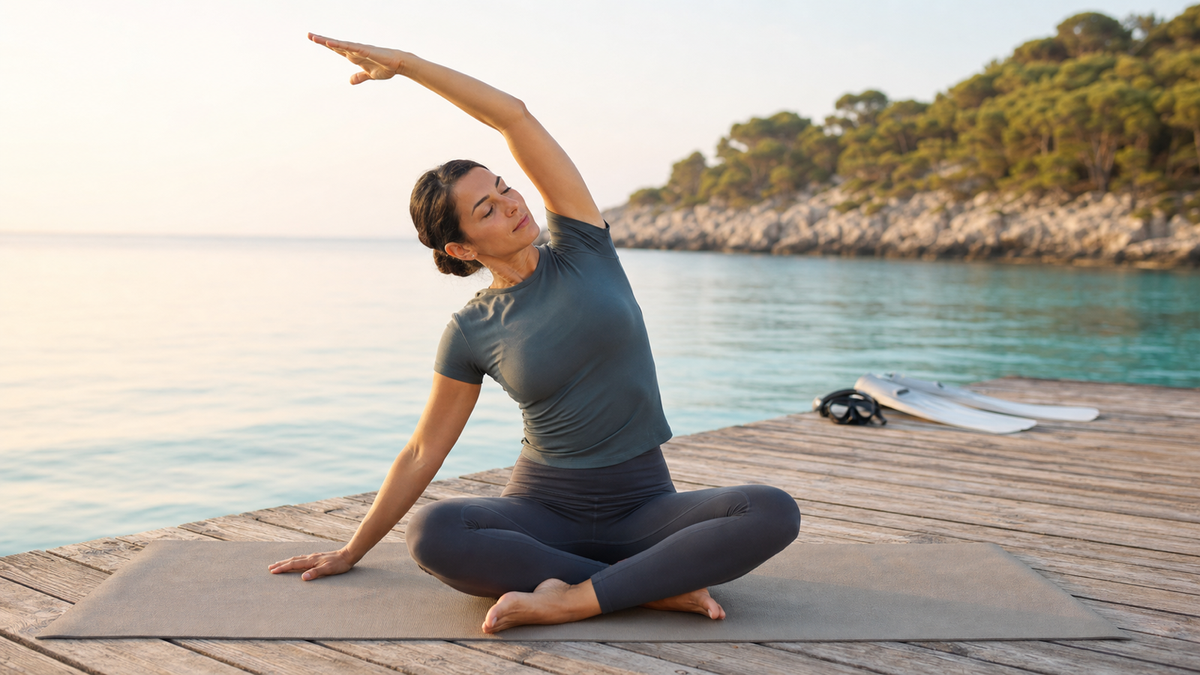
For a dry-land freediver, the exhalation side is the underrated half. Depth compresses your lungs far below resting volume, and a diaphragm that has never practised being high and relaxed is the one that spasms. Even if you never dive deep, empty-lung comfort transfers directly to calmer holds: the first contractions come from that same muscle.
The mobility side is the part that has actually been measured. In a trial of freediving-style breath training run against pulmonary rehabilitation in COPD patients, the freediving arm produced additional physiological effects, including better respiratory-muscle mobility and a lower resting breathing frequency (Csizmadia et al., 2022, PMID 36141823). The methodology sets the limits of that claim. The participants were COPD patients in a rehabilitation setting, not freedivers chasing a personal best, so it tells you the breathing apparatus becomes more mobile — not how many seconds that buys you.
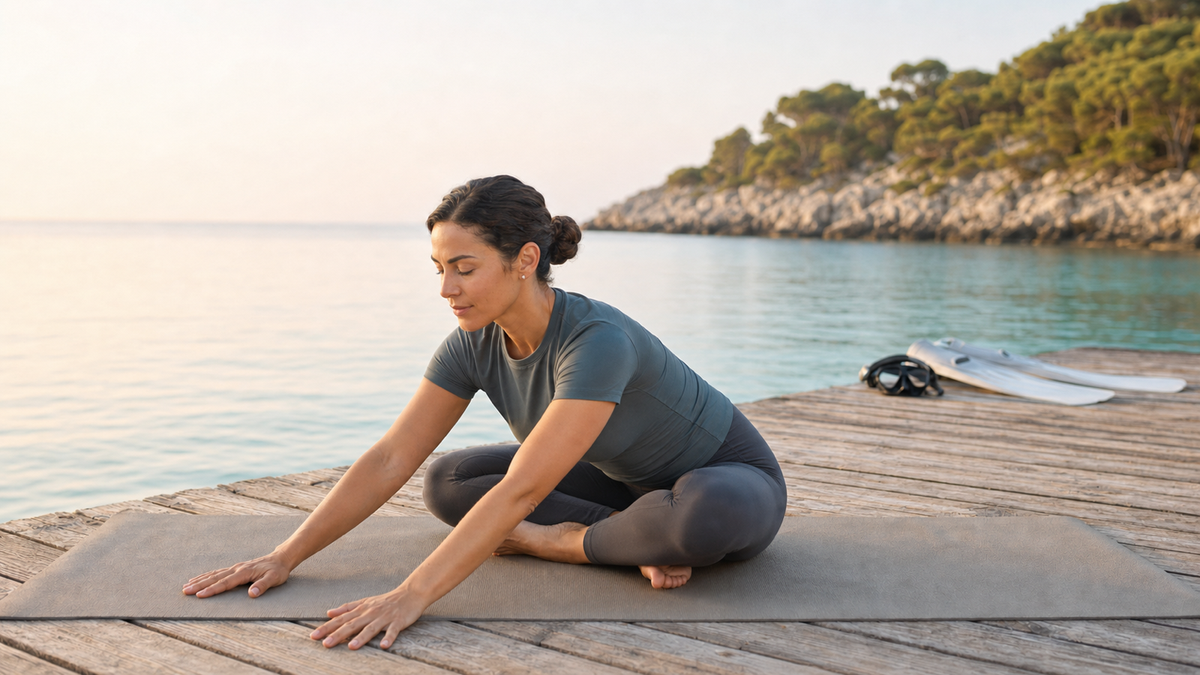
Uddiyana bandha, step by step
Uddiyana bandha is the “upward abdominal lock” borrowed from pranayama, and it is the single most useful diaphragm stretch a freediver can do. It is performed on empty lungs, which keeps it on the safer end of the spectrum. The guided sequence below walks you through the full routine with timings; here is what the key movement should feel like from the inside.
After a complete, unforced exhale, you close the throat and perform a mock inhale: the ribcage lifts and expands as if breathing in, but no air enters. The vacuum pulls the abdominal wall up and under the ribs, and the diaphragm gets drawn upward into a stretch it never reaches during normal breathing. Hold it only as long as it stays comfortable — a few seconds is plenty at first — then release the throat, let the belly drop, and breathe in gently. Never inhale against the closed throat; release first.
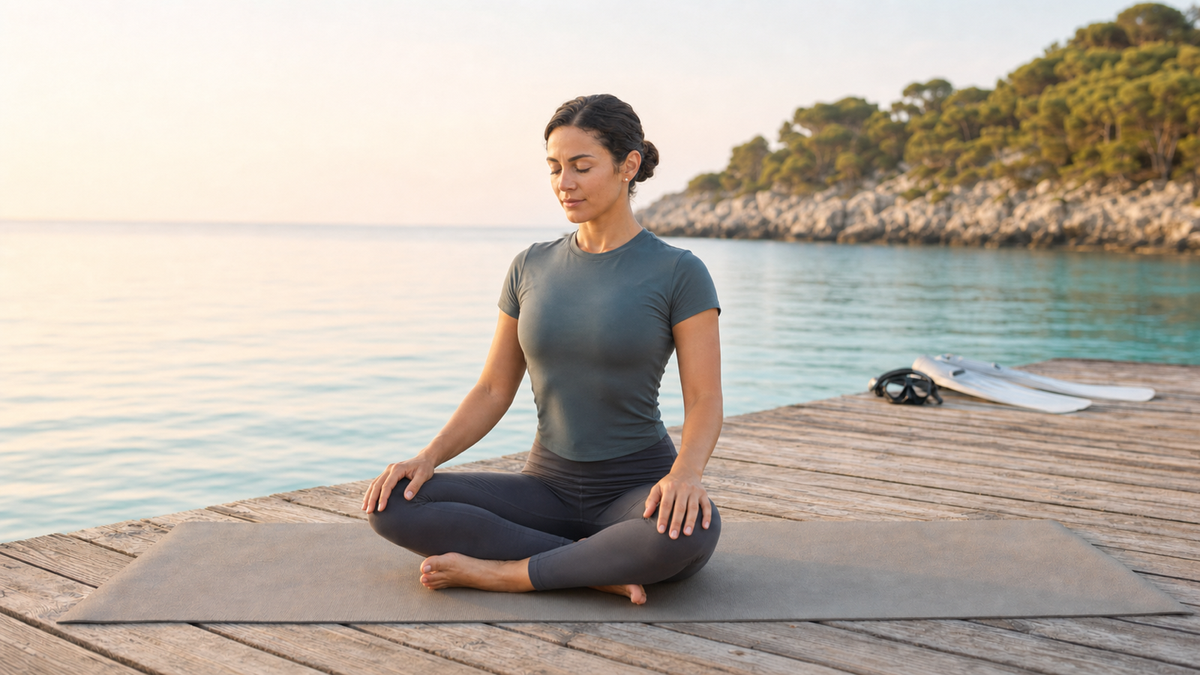
Diaphragm stretch, step by step
A dry, seated sequence. Tap through the steps — never rush, and never do the full-lung phase near water.
-
Cross-legged or on a chair, spine long, shoulders soft. Breathe normally and settle.
-
Breathe all the way out, then gently round forward over an empty belly to feel the lower ribs open. Stay relaxed.
-
Safety
On the empty lungs, mock-inhale without taking air — the belly draws up under the ribs. Hold briefly, then release before you feel any strain.
-
Safety
A comfortable 80 % inhale (never a maximal pack), then gently open the chest and side ribs. Keep the throat soft.
-
Return to easy breathing. Dizziness means stop for the day — you went too far.
Tap a step
Three feel-checks that matter more than any timing:
- The face stays soft. If your jaw or eyes are straining, the stretch is too ambitious.
- Release before the urge to breathe arrives. This is a stretch, not a breath-hold session — retention training belongs in the kumbhaka article .
- Empty stomach, always. Uddiyana with food in the stomach is somewhere between unpleasant and genuinely risky. Wait at least three hours after a meal.
Safety: this is the strictest section of this blog for a reason
Stretching sounds harmless. Combined with breath manipulation, it is not automatically so:
- Dry only, and never near water. Full-lung stretches and empty-lung locks both change the pressures and blood-gas picture in ways that can end in a blackout without warning. On a mat, a blackout is a frightening story. In or beside water, it can be fatal. There is no version of this routine that belongs at the pool.
- No packing. “Lung packing” (gulping extra air on top of a full inhale) combined with stretching is an advanced, coach-supervised practice with real injury risk — lung squeeze and blackout included. Nothing in this article uses it, and your 80 % inhale is a rule, not a suggestion.
- Stop at the first sign of dizziness, tunnel vision, tingling or nausea. Not “one more round” — done for the day. These symptoms mean circulation or blood gases are being pushed, and a stretch has no business doing that.
- Sit on the floor, not on a stool. If you do get light-headed, you want nowhere to fall.
- Know your starting point. A relaxed baseline test tells you whether your training is working — stretching should make your breathe-up feel easier long before it shows up in any number.
If you have high blood pressure, a hernia, are pregnant, or are recovering from abdominal or chest surgery, skip uddiyana bandha entirely and talk to a doctor first.
Fitting lung and diaphragm stretching into your training week
Stretching earns its place by being boring and regular, not intense:
- Frequency: 3–5 short sessions a week beats one heroic Sunday session. The whole routine above takes under five minutes.
- When: mornings on an empty stomach are ideal for uddiyana; the inhale stretches slot nicely before a CO₂-table session as part of settling in.
- Progression: add gentle range and comfort, not duration under strain. If week four feels easier at the same range, it is working.
- Pair it: stretching is the mobility layer; the actual apnea stimulus still comes from your tables and holds.
Judge it by feel, not by a number. For instance, say a comfortable 80 % inhale with soft shoulders lasts a full minute in week four, where week one felt strained at thirty seconds. That is the adaptation, even though a spirometer would report the same total lung capacity in both weeks. The measurable version of that shift is what the COPD trial picked up as improved respiratory-muscle mobility and a slower resting breath (PMID 36141823).
Sources
- Csizmadia, Z. et al. (2022). Freedive Training Gives Additional Physiological Effect Compared to Pulmonary Rehabilitation in COPD. International Journal of Environmental Research and Public Health 19(18):11549. PMID 36141823
- Quanjer, P. H. et al. (2012). Multi-ethnic reference values for spirometry for the 3–95-yr age range. European Respiratory Journal 40:1324–1343. PMID 22743675
- Schagatay, E. et al. (2012). Size matters: spleen and lung volumes predict performance in human apneic divers. Frontiers in Physiology 3:173. PMID 22719729
Every source above links to its abstract, and each link was opened and re-read against this text during the last editorial pass. Where a study measured trained athletes rather than beginners, for example, the article says so instead of generalising.
Written by Jan Luther — keen amateur freediver, and the developer behind Apnea Trainer since 2010. About this blog explains how sources are chosen; the imprint has the contact details for corrections. All articles
Frequently asked
Can stretching increase your lung capacity?
No, not meaningfully. Total lung capacity is a structural property set by height, sex, age and the size of your thoracic cavity — the same variables the international spirometry reference equations use to predict it. What stretching does improve is ribcage compliance and diaphragm mobility, so the volume you already have becomes easier and calmer to reach.
Does lung volume matter for freediving performance?
It helps, but it is largely something you are born with. Schagatay et al. (2012) found that spleen and lung volumes predicted performance in apneic divers, which confirms the volume is real without making it trainable. Treat it as a fixed starting point and train the things that do respond — CO₂ tolerance, relaxation and ribcage flexibility.
What is uddiyana bandha and is it safe?
Uddiyana bandha is the "upward abdominal lock" borrowed from pranayama. After a complete exhale you close the throat and perform a mock inhale, so the vacuum draws the abdominal wall up under the ribs and stretches the diaphragm. It is done on empty lungs, which keeps it on the safer end of the spectrum. Do it dry, seated on the floor, on an empty stomach, and skip it entirely if you are pregnant or have high blood pressure, a hernia, or recent abdominal or chest surgery.
How often should freedivers do stretching?
Three to five short sessions a week beats one long one. The full routine takes under five minutes, and progress means more comfort at the same range rather than longer holds under strain. If week four feels easier at the same range, it is working.

Apnea Trainer is a breath-hold training app for iPhone, Apple Watch and Android. It guides you through timed breathing cycles and builds progressive tables around your personal bests. On Apple Watch the whole session runs on your wrist — live heart rate and haptic cues for every phase.
Keep reading
Kumbhaka: What Yogic Breath Retention and Freediving Have in Common
Pranayama’s retention and a freediver’s CO₂ table are the same mechanism in different vocabularies. What holds up under measurement — and what does not.
Find Your Breath-Hold Baseline: A Free Interactive Test (No Water Needed)
Before you train, measure. A guided dry test — paced breathing, one relaxed max hold — and an honest reading of what your result means.